

with the purchase of an American Flag


Do not leave a telescoping flagpole fully extended through a storm unless its manufacturer explicitly permits that use under the forecast conditions. Remove the flag and lower the pole according to its instructions before severe weather arrives; a wind rating is not permission to ignore lightning, installation requirements, or flag-size limits. This 2026 guide explains how to make that decision without borrowing a rating from a different pole.
TL;DR
- Can you leave a telescoping flagpole up in a storm? Only within the manufacturer's documented operating limits.
- Remove the flag and lower the pole before severe weather arrives, following the manufacturer's instructions.
- Federalflags commercial flagpole ratings do not establish a wind limit for your telescoping flagpole.
- Stay indoors once thunder or dangerous winds begin; do not attempt last-minute adjustments.
A storm plan beats a last-minute adjustment
Your decision should happen while the weather is calm, not while the flag is snapping and the pole is moving. A telescoping design lets you reduce the pole's height, but that feature does not establish its storm rating or tell you how to secure it safely.
Start with the instructions for your exact model. If you are still choosing a pole, the telescoping flagpole guide is a starting point for comparing designs; the manufacturer's operating instructions remain the authority for storm preparation.
For your 2026 storm plan, write down the prescribed lowering procedure and keep it somewhere accessible indoors. Decide who will handle the flag before weather deteriorates. Nobody should need to learn how a locking collar works during a thunderstorm.
Can you leave a telescoping flagpole up in a storm?
Only leave it extended when the manufacturer's instructions expressly allow the forecast conditions and your installation meets those instructions. If you cannot establish that, prepare the pole for severe weather before the storm reaches you.
The following sequence separates preparation from emergency response. It is not a substitute for the model's manual, especially when the pole has an unfamiliar locking mechanism or requires removal from its mounting sleeve.
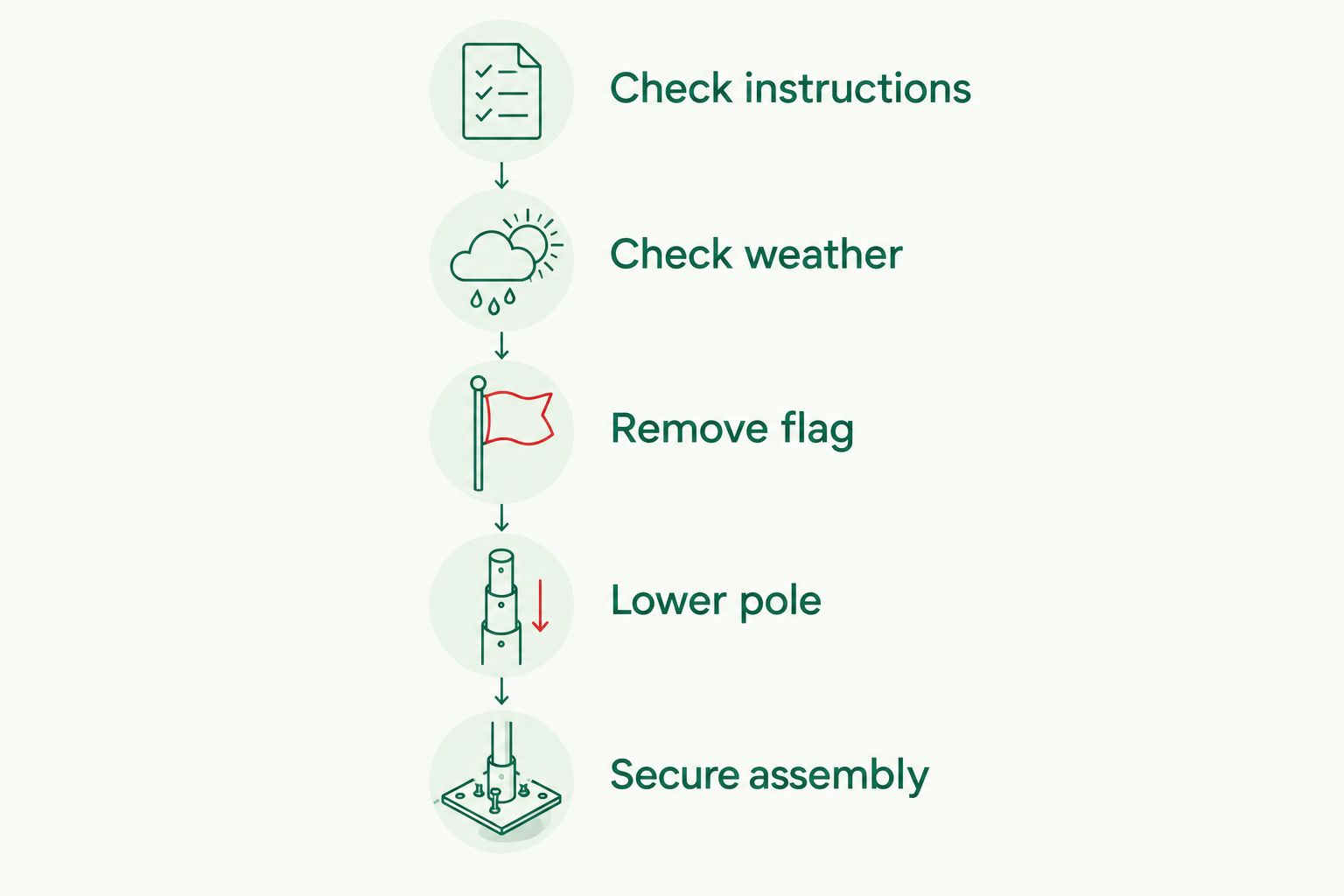
- Check instructions. Identify the model, its wind restrictions, the permitted flag dimensions, and any requirement to lower or remove it during severe weather. Confirm whether a stated rating applies with a flag attached.
- Check weather. Read local alerts and the forecast gusts, not just the average wind speed. Schedule preparation before thunder, strong winds, or other hazardous conditions reach the property.
- Remove flag. Follow the prescribed procedure for detaching the flag and any removable accessories. Do not add a second flag or leave an oversized flag attached because the pole previously handled ordinary weather.
- Lower pole. Use the manufacturer's sequence for releasing and lowering sections. Keep control of each section, stay clear of pinch points, and stop if a lock or tube binds.
- Secure assembly. Place the pole in the manufacturer's prescribed storm configuration. Do not improvise braces, straps, drilled holes, or locking arrangements.
Once thunder is audible, move indoors rather than finishing the job outside. National Weather Service lightning safety guidance calls for shelter in a substantial building or an enclosed hard-topped vehicle. Lowering a flagpole is not a reason to delay shelter.
Fully extended: use only within documented limits
A fully extended pole provides the intended display height, but it also leaves the full assembly exposed to wind. Whether that configuration is acceptable depends on the model's instructions, the flag attached, and the installation—not on the word telescoping.
Best for: Routine display within the manufacturer's stated operating conditions. The benefit is full-height visibility; the limitation is that you must change the setup when the instructions require storm preparation.
Do not treat an uneventful previous storm as a test result. It does not establish the next storm's gusts, the current condition of the joints, or the strength of the mounting arrangement. Your 2026 decision should rest on documented limits, not remembered weather.
If the instructions call for lowering before high winds, follow that requirement even when the pole looks steady. Waiting for visible bending or movement turns a planned adjustment into a hazardous outdoor task.
Lowered: follow the prescribed storm configuration
Lowering a telescoping pole reduces its exposed height. It does not create a new wind rating, and it does not automatically make the installation safe for every storm.
Best for: Pre-storm preparation when the manufacturer directs you to collapse the pole. The benefit is using the design's lowering function; the limitation is that the locks, sleeve, and remaining exposed sections still need the specified handling.
Check whether the instructions require the collapsed sections to be locked, the flag removed, or the entire assembly taken out of its sleeve. These are different configurations. Leaving a flag attached to a partly lowered pole is not equivalent to completing the prescribed preparation.
Never force a jammed section down. If the weather is still calm, resolve the fault using the manufacturer's troubleshooting instructions. If hazardous weather has arrived, leave the pole alone and take shelter.
Removed and stored: only when the design permits it
Some pole instructions include removal from the mounting sleeve. Follow that procedure only when it applies to your model and you can complete it safely before the storm.
Best for: Models whose storm instructions specifically require or permit removal. The benefit is taking the removable assembly out of outdoor exposure; the limitation is that you must handle and store it without damaging sections or hardware.
Keep removed components where they cannot roll, fall, or obstruct an exit. Follow the instructions for covering or protecting an empty sleeve, if provided. Do not assume that a sleeve, foundation, or mounting bracket is removable just because the upper pole telescopes.
| Configuration | Best for | Practical benefit | Important limitation |
|---|---|---|---|
| Fully extended | Routine display within documented limits | Maintains full display height | Does not override storm restrictions |
| Lowered | Manufacturer-directed storm preparation | Reduces exposed height | Does not establish a new wind rating |
| Removed and stored | Models with an approved removal procedure | Takes the removable assembly out of exposure | Requires safe handling and storage |
Why storm limits vary between flagpoles
A wind-speed figure only helps when you understand the conditions attached to it. Read the complete specification rather than comparing headline numbers alone.
- Pole design and height: A commercial pole and a telescoping residential pole are different structures. A rating for one does not transfer to the other.
- Flag size and number: Flags add wind load. Confirm which flag configuration the manufacturer permits instead of assuming every flag fits the same rating.
- Rating conditions: Establish whether the stated limit describes a flagged or unflagged pole and what wind-speed definition it uses.
- Installation: The sleeve, foundation, mounting arrangement, and assembly must match the manufacturer's requirements. A rating does not excuse an incorrect installation.
- Component condition: Damaged tubing, slipping locks, loose fittings, or movement at the base require attention before the pole returns to service.
- Weather hazards: Lightning, flying debris, flooding, and unsafe access are separate from the pole's stated wind resistance.
For 2026, keep the relevant specifications together with the installation instructions. A screenshot of a headline wind rating is not enough; you need the conditions that explain what the number means.
The useful question is not simply how much wind the pole can withstand. It is whether your exact assembly, flag configuration, and installation meet the documented conditions.
Does a commercial wind rating apply to a telescoping pole?
No. A commercial flagpole's wind rating belongs to that specified product, not to a different telescoping pole with a similar height or material.
For example, the Federalflags catalog identifies the following commercial poles with different heights and stated ratings. These are product-specific examples, not recommended operating limits for a telescoping installation.
| Commercial pole example | Stated rating | Best for considering | What the figure does not establish |
|---|---|---|---|
| 20 ft commercial aluminum flagpole with external rope halyard | 85 mph | Buyers comparing a commercial pole at this height | A safe wind limit for a telescoping pole |
| 30 ft commercial flagpole with external rope halyard | 50 mph | Buyers reviewing a taller commercial installation | Permission to leave any flag attached in severe weather |
The 20 ft example carries an 85 mph stated rating, while the 30 ft example carries a 50 mph stated rating. Height alone therefore does not tell you which product has the higher listed wind rating. Neither figure establishes the flag configuration or installation conditions without the supporting documentation.
Federalflags is best for homeowners and businesses seeking made-in-USA flags and flagpoles. Its commercial flagpole specifications give buyers concrete points to compare, but choosing a rated product still requires checking its installation and operating requirements. No catalog label replaces that check.
Should you remove the flag before a storm?
Remove the flag before severe weather arrives, following your pole's instructions. Taking the fabric off removes the flag's contribution to wind load, but it does not make an extended pole storm-proof.
Plan enough time to detach clips or other approved attachments without rushing. If your setup requires collapsing the pole to reach the flag, follow that sequence rather than climbing, pulling on the fabric, or improvising a release.
A heavy-duty flag is not a storm-safety device. Fabric durability and structural wind resistance are different considerations. Do not leave a flag flying solely because its description emphasizes outdoor use or durability.
What should you check before extending the pole again?
Wait until conditions are safe, then inspect the assembly before raising it. Your 2026 post-storm routine should cover the pole, locking mechanisms, attachments, and mounting area—not just whether the flag looks intact.
Look for bent sections, cracks, unusual gaps, loose hardware, or sections that no longer slide and lock normally. Check the ground or mounting area for displacement, erosion, or damage. Do not stand beneath a leaning or visibly damaged assembly to troubleshoot it.
If anything has shifted or stopped working normally, keep the pole out of service and contact the manufacturer or a qualified installer. Do not straighten bent tubing or alter a lock unless the manufacturer provides that repair procedure.
Before restoring the flag, confirm that the sections lock as instructed and the attachments are serviceable. A pole that survived the storm still needs inspection before its next full-height display.
FAQ
Can you leave a telescoping flagpole up in a storm?
Only leave a telescoping flagpole extended when its manufacturer's instructions explicitly permit the forecast conditions and your installation meets those requirements. Otherwise, remove the flag and prepare the pole as instructed before severe weather arrives.
What wind speed is safe for a telescoping flagpole?
The safe operating limit is the one documented for your exact model and configuration. Do not use a commercial pole's rating or another telescoping model's rating as a substitute.
Is a collapsed telescoping flagpole safe in every storm?
No, collapsing a telescoping flagpole does not make it safe in every storm. Follow the manufacturer's requirements for locking, flag removal, storage, and installation.
Should I lower my flagpole if I hear thunder?
Take shelter when you hear thunder rather than going outside to lower the flagpole. Complete flag and pole preparation before the storm reaches your property.
Can I leave an American flag attached to a lowered pole?
Remove the American flag for severe-weather preparation unless your manufacturer's instructions specifically direct otherwise. A lowered pole with a flag attached is not automatically an approved storm configuration.
Does a hurricane-rated commercial pole prove my telescoping pole is safe?
No, a hurricane-rated commercial pole does not establish a telescoping pole's wind resistance. Federalflags commercial flagpole ratings apply to the specified products, not unrelated assemblies.
Can I raise my telescoping flagpole immediately after a storm?
Inspect the pole and mounting area after conditions become safe before raising it. Keep the assembly out of service if sections are bent, locks malfunction, or the base has moved.
One last thing
Practice the lowering procedure on a calm day. Find the release points, confirm that each section moves normally, and identify where the removed flag and accessories will go. A familiar procedure is easier to complete without forcing a lock or losing control of a section.
Make that practice part of your 2026 storm preparation, not an experiment during a weather alert. The most useful feature of a telescoping pole is the ability to prepare it early; use that feature while you can still work safely.

