

with the purchase of an American Flag


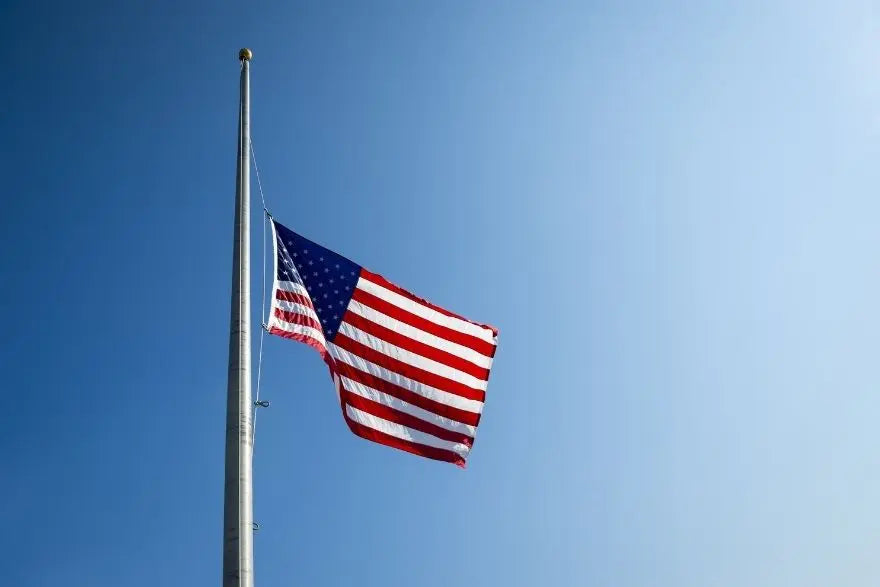
When the nation is in a state of mourning, we know it because the American flag is not hoisted to the very top of the flagpole where it usually belongs. But if you ask people what this is called, you’ll get dueling responses—some folks will tell you the flag is being flown at “half-mast,” while others will tell you it’s at “half-staff.” On the surface, people are telling you the same thing—namely, that the flag is flying half as high as it normally would. But in the United States, there’s a difference between half-mast and half-staff that you should be aware of.
Looking for today’s flag status? See our live tracker: Are Flags at Half-Staff Today? — updated daily with current national and state half-staff orders.
Half-Mast vs Half-Staff
The sight of the American flag flying at half-mast or half-staff is a solemn and widely recognized gesture that signifies mourning, respect, or remembrance. While these terms are often used interchangeably, they have distinct meanings and contexts in which they are employed.
In this article, we'll explore the differences between American flags at half-mast and half-staff.
Take a look!
Half-Mast Flags
Unsure why the flag is at half-mast? Half-mast refers to a flag flown from a ship’s mast. When the American flag is flown from a land-based flagpole, the correct term is half-staff. Under the U.S. Flag Code, a flag at half-staff is flown one-half the distance between the top and bottom of the staff—halfway up the pole. It is traditionally employed to show respect for the passing of a prominent government official, military figure, or a national tragedy.
The concept of lowering flags as a symbol of mourning or distress has its origins in naval customs. During periods of mourning, ships would lower their flags to leave room at the top for a “phantom flag” of sorts.
Ships would fly these flags from their masts, the tall beams that support a ship’s sails. Therefore, a flag that’s not raised to its full height is said to be at “half-mast.” As the custom made its way onto land, it retained its naval name—in most countries, that is.
How To Fly Your American Flag at Half-Staff
- Raise your flag all the way to the top of your flagpole
- Lower it to the halfway point between the top and bottom of your flagpole
- At the end of the day, raise the flag back to the top before lowering it all the way down
Half-Staff on a Wall-Mounted Flagpole
Wall-mounted flagpoles have no rope for lowering the flag, and the Flag Code doesn’t address them directly. If your wall-mounted bracket has multiple positions, you can lower your pole to the horizontal position. If your bracket doesn’t have multiple positions, you can attach a black ribbon at the top of the pole and leave it in place for the duration of the half-staff display.
Half-Staff Flags
It’s a bit of a custom in the English language to assign certain words exclusively to maritime use. Anyone who’s ever been on a recreational boat knows that left and right become “port” and “starboard,” or that front and back become “stem” and “stern.” American English observes a distinction between land and sea when it comes to flying flags in mourning. In the United States, therefore, flags flown on land are not flown from masts, but from staffs.
However, the United Kingdom and the rest of the English-speaking nations that once comprised the British Empire have had no qualms about bringing the term “half-mast” to dry land. The Associated Press Stylebook recommends “half-staff” in American usage, but a trip across the pond or even a trip across the Canadian border will find flags on land flying at “half-mast.” So, use the term “half-staff” at home in the States—unless, of course, you’re an inveterate Anglophile.
To summarize, "half-staff" is the term used for flags on land, particularly in the United States. It describes a flag flown one-half the distance between the top and bottom of the flagpole. When the American flag is flown at half-staff, it conveys a similar message of respect and mourning. This custom is most often observed following the death of a government official, military personnel, or in response to a significant national tragedy.
When should the American flag be flown at half-staff?
A half-staff flag is most often observed following the death of a government official, military personnel, or in response to a significant national tragedy.
On Memorial Day the flag should be flown at half-staff from sunrise until noon only, then raised briskly to the top of the staff until sunset, in honor of the nation’s battle heroes.
Because no flag may fly higher than the U.S. flag, lower state and other flags to half-staff as well, or take them down.
Half-Staff and Half-Mast Protocol
Whether you say “half-staff” on American soil or “half-mast” anywhere else, what matters more than the difference between half-mast and half-staff is that you follow proper protocol while flying your flag in mourning.
Remember that when you lower a flag to half-staff, you must first hoist it to the very top of the flagpole before lowering it. And this isn’t a decision you can make for yourself—half-staff observances are ordered by the President, or by a state or territorial governor or the Mayor of D.C. for specific local losses—not by individual flag owners.
In conclusion, the terms "half-mast" and "half-staff" are closely related but have distinct meanings and applications. The key distinction is that half-mast is nautical in origin, while half-staff pertains to land-based flag displays in the United States.
Buy Your American Flag Here!
If you want to show your patriotism in times of joy and sorrow alike, Federal Flags is your flagpole store, where you can fly your flag at half-staff—or, if you prefer, half-mast. Shop our flag poles for your house and yard, all made in the USA and backed by a lifetime shaft warranty.
At Federal Flags we provide high-quality giant American flags that have been masterfully crafted and proudly made in the USA. Get in touch with our team today and we will advise you on the best option for you. You can also email us directly at info@federalflags.com. We look forward to hearing from you!
7 comments


Thank you so much for this information. This year my sister and I put a 25’ flagpole at our mothers douse, as a memory for our father who passed away in 2000. I have been wanting to do this for 25 years. So I ran some conduit under a cement slab to the pannel box. Now the us flag at my mother’s residence flies 24/7. My coduit run allowed us to have power, and with that powers I put a photocell at the base of the pole. When night falls the light illuminates our us flag. With saying all this, it’s important for me to be familiar with rules and ediquit for flying the us of America flag.
This is a very informative article, and I appreciated learning the difference between half-mast and half-staff. My concern is that you refer to the flag of the United States of America as the American flag when there are actually 2 Americas, North and South, and they are continents, not countries.